
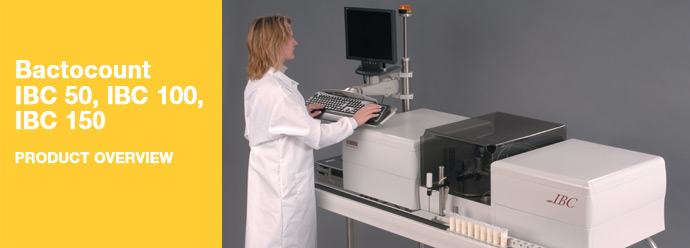
Bacteria Enumeration at 50, 100 or 150 Samples Per Hour
Measures: bacteria count
The BactoCount IBC is a fully automated instrument that uses flow cytometry for the rapid enumeration of individual bacteria in raw milk. The high processing speed of this model makes it the ideal solution for mid to large size laboratories that need an easy to maintain, exceptionally fast bacteria counting system.
This model is available in three different configurations (BactoCount IBC 50, BactoCount IBC 100, and BactoCount IBC 150), making it easy to select an instrument that meets the needs of your laboratory or dairy.
- Capable of analyzing 50 – 150 samples per hour
- Use of a standard computer offers flexible data output options
- Fully automated Autosampler provides a steady flow of samples
- Low maintenance design
Evaluated by the CECALAIT and IAI reference laboratories.
The IBC can be used as an alternative method to the IDF 100B:1991 and AOAC 986.33 reference methods for the rapid and accurate determination of the hygienic quality of cow, sheep, and buffalo raw milk for payment purposes.
Technical overview & principle of operation
The IBC is a fully automated instrument that uses a proprietary process based on flow cytometry for the rapid enumeration of individual bacteria in raw milk. The practical application follows a simple general principle: the cells are stained with a fluorescent dye that inserts into the intracellular DNA followed by detection and enumeration by a flow cytometry based cell counter.
The IBC consists of five modules; the cell counter, the carousel, the pumping and filtration, the Autosampler, and the computers.
1. The counter
The counting assembly includes a powerful solid state laser, a flow cell, set of optics, a narrow band filter, and a highly sensitive photo multiplier. The bacteria are aligned in the flow cytometer and exposed to an intense laser beam to excite the fluorescent marker intercalated into the bacterial DNA. The fluorescence pulses are collected with the optics, filtered with a narrow band filter, and detected with the photo multiplier. The pulses are sorted based on duration and intensity and then translated into individual bacteria counts (IBC’s). Using parallel results of IBC’s and traditional plate counts the instrument can be calibrated to output results in CFU/mL. The counting assembly is compact, enclosed and regulated at 30°C (86°F) to provide a highly stable environment.
2. The carousel
The carousel assembly consists of the carousel, a sonic station, a wash station for the carousel, and a pipetting station. The carousel has 33 sample wells and is temperature regulated at 50°C (122°F). The milk and incubation reagent is dispensed simultaneously into the wells and subjected to a chemical treatment, heat treatment and two sonications in order to stain the bacteria, separate bacterial clumps and chains, and break down all interfering components. The wells and lines are automatically rinsed after each analysis.
3. The pumping and filtration
The pumping/filtering of the working solution and the waste removal is done primarily from the diaphragm pumps. The filtration station is located in the same area as the diaphragm pumps and the working solution reservoir. The filtration station consists of three 0.2 µm filters. The working solution reservoirs are equipped with level sensors to monitor the liquid levels and provide warnings if necessary.
4. The Autosampler
The IBC uses a belt driven conveyor that is typically setup with a 20-vial rack. The conveyor’s pipette is used as both a stirrer and an empty bottle probe to detect fluid levels. The conveyor’s wash station washes the outer part of the pipette while the internal part of the pipette is back flushed with a cleaning solution after each sample.
5. The computers
The IBC is equipped with a powerful internal industrial computer. The internal computer is used to operate the instrument and send all the data and diagnostics to the external computer. The external computer is a standard personal computer or workstation running a version of Microsoft Windows (currently the system has been tested using Microsoft Windows 95, Windows 98, Windows 2000 and Windows XP).
Analysis performance
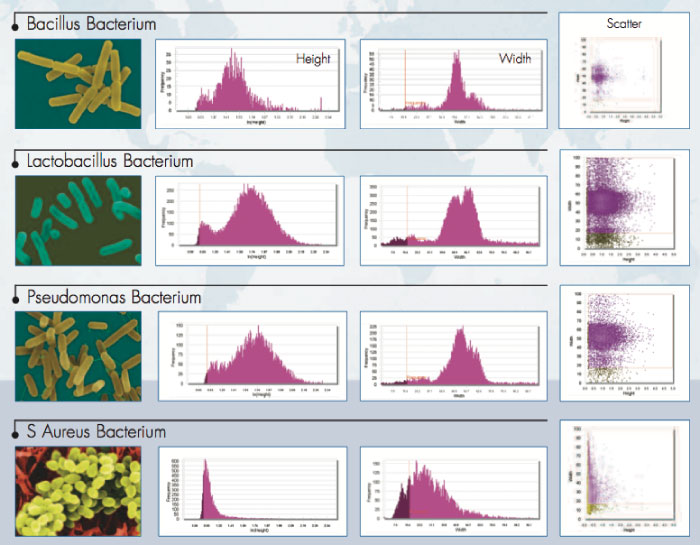
The graphs below display typical peak, width and scatter distributions obtained with the BactoCount method of the predominant bacteria species used for the assessment of the hygienic quality of raw milk:
News
Bentley sponsors the IDF/ISO event in Rotterdam on June 3rd-7th
Bentley is showing at the ICAR congress in Aarhus, May 29th – 31st